Thursday, May 1, 2014

Mao Museum

George and Rich

1. Little Red Book-Selected speeches from Mao's history


http://www.morningsun.org/images/index.html#

2. Steel-Mao makes the  people make steel which causes a famine


http://blogs.isb.bj.edu.cn/16joycet/files/2013/05/Backyard-Furnaces1.jpg

 3. Propaganda-Mao used propaganda to make a better image of himself


http://globalvoicesonline.org/wp-content/uploads/2013/12/mao-propaganda.jpg

 4. Long March-Mao and his army fled from the nationalists


http://richgibson.com/MAS/wp-content/uploads/2013/03/MaoTseTung-LongMarch.jpg

 5. Flag of the Peoples Republic of China-Mao founded the Peoples Republic of China


http://upload.wikimedia.org/wikipedia/commons/thumb/f/fa/Flag_of_the_People's_Republic_of_China.svg/1500px-Flag_of_the_People's_Republic_of_China.svg.png

MMoM (Modern Musem of Mao)

Mao Museum 
Alex & Zoe 

Mao encouraged literacy and urged for more women's rights. This poster is a slogan about secondary school, and they were on walls all throughout the cities, all with different messages.

People in the countryside studied Mao's ideas. He changed the outlook of the working people, produced a gigantic material force and brought about a new leap in agricultural production.

A medical worker giving shots to children. The sign in the background contains a Mao quotation: "actively prevent and heal people's illness, and carry out medical and health work for the people."

"A general store in Tsao Yang, one of the newly built suburbs of Shanghai. The population of this suburb has "leaped ahead," along with the accelerated production of Shanghai, having increased by seven thousand families since its birth."


"Modernization and economic success lead to increased mobility and wellbeing for all. It starts with a motor cycle and maybe ends with a car. The woman has worked in the fields, probably sprayed fruit trees with insecticide. Note her fashionable wristwatch!"

Mao Museum

Mao Museum


Map of the Long March
westshore.hs.brevard.k12.fl.us

This map illustrates Mao and the Communists' journey in order to escape the Nationalists. The March lasted about a year and many of the soldiers on the march died. However, the march was important because it saved the Communists party. Therefore, this map belongs in the museum because Mao's plan for escape may have cost many lives, but ultimately saved his movement.

Photo of Mao's Speech Proclaiming the People's Republic of China
www.telegraph.co.uk

Mao's forces are victorious, and the Communists reassert their power. This photo was taken on October 1, 1949 when Mao declared the establishment of the People's Republic of China. This photo would be in the museum because it marks the beginning of Mao's 27 year regime and the establishment of the government of China that still exists under the same title today.


Propaganda Poster: "Chairman Mao gives us a happy life, 1954"
Chairman Mao gives us a happy life, 1954
In order to control the potentially revolutionary peasants, Mao and the Communist party used propaganda posters to brainwash the masses. This poster depicts a happy middle-class Chinese family who are attributing their lifestyle to the picture of Mao above their table because the father is pointing to him. This would be in the museum because Mao's propaganda was ultimately and he was very well liked by the commoners.

Great Leap Forward: Construction in Beijing
Themes thumbnail
http://www.moma.org/interactives/exhibitions/2010/henricartierbresson/#/themes/8/234.html
In this picture, Beijing is being transformed into a modern city. The houses in the picture are old and run down, but after construction they will have four or five floor. In addition, the crowded and beaten down paths are going to be paved streets. This picture should be in the Museum because it reflects the positive changes under Mao's rule.

The Little Red Book

Picture from: jamesmys.blogspot.com

The Little Red Book was composed of various quotes by Chairman Mao. The book overs advice for various situations that one may encounter while being a follower of Mao. While this book was initially used to increase Mao's popularity among the soldiers, his book was widely circulated during the Cultural Revolution. This book would be in the museum because it is a symbol of Mao's rule and his influence over society.


By Lauren and Abby


Wednesday, April 30, 2014

Mao Museum

“Glorious Years”

Although Mao was a powerful leader, he was also loved by his people. He was a true peasant and understood his people. This picture shows how in touch Mao was with his followers. He didn’t put himself above others; Mao talked to and listened to his followers. His followers loved him because he put himself on the same level.


The Long March is a very well known event during Mao’s life. The Long March was a retreat by the communists to get away from the nationalists. It was a very long march, hence the name, that went along the outskirts of China through mountains and desert. During the march about ninety percent of the communists were killed or injured. Though the communists lost a majority of their people during the march, it was a strategic move that let the communist live to fight another day. 

“Mao’s Little Red Book”

Mao wrote everything down in his little red book. The Little Red Book was a pamphlet used to instruct people on how to apply Mao’s thoughts to problems encountered in the pursuit of the revolutionary cause and plan. It was the guidebook for the people of China so that they could follow Mao. 

The Personal Files show the dark side of the Cultural Revolution. It is a record of all the people who had their things confiscated and the people who were sent into exile. Many of the people of China were affected negatively during the Cultural Revolution. Along with people being exiled and having their things taken away, many people died.


By: Allison and Kimmi


Mao Museum

This picture shows a bunch of kids maybe the red guard holding the Little Red Book. This picture would be in a Mao museum because the Little Red Book was one of Mao's signature movements.http://www.moma.org/


The picture above is a Chinese propaganda poster for "The Great Leap Forward." This picture is significant because in the picture the people are happy and a lot of food to eat where as in the real Great Leap Forward the population of China was starving.http://www.chineseposters.net/


The cannons of war were not only used for fighting but for demonstrations as well. Mao Zedong believed that to show power one must demonstrate power and so these cannons were put in the main square during many celebrations. This picture shows not only the cannons but many men standing behind them Mao Zedong wanted the Chinese to feel safe by showing his numbers. http://www.moma.org/


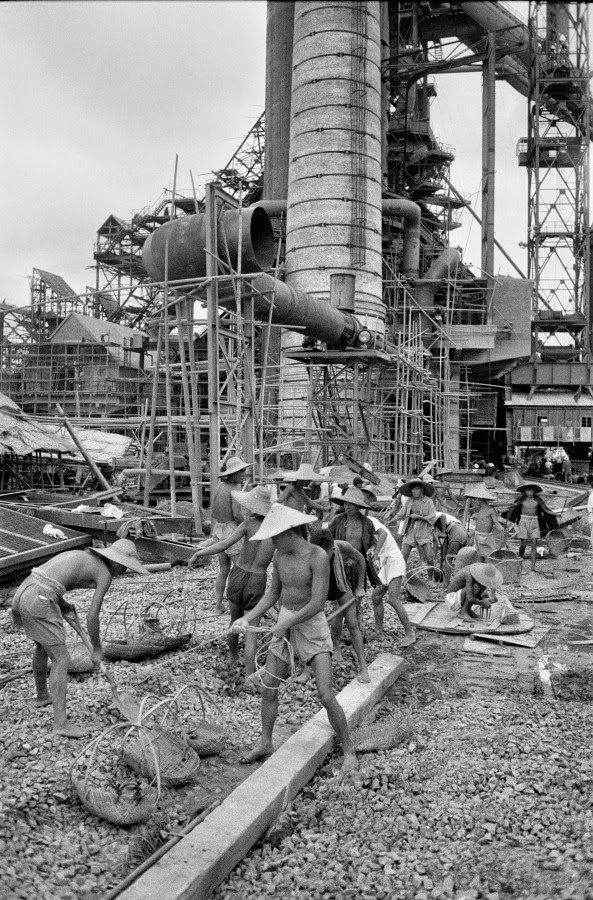
This picture shows that even under the rule of Mao Chinese citizens were worked with immense pressure and brutality. The people had to work with little protection on hard rocks and gravel. http://www.moma.org/


This picture shows the slogan that Mao wanted to display visually to all of the Chinese people, this translates to "Still bigger, Still better, More quickly, More frugally" http://www.moma.org/ 


Will and Shannon


 (1) The peasants are working to meet Mao’s quota of 10,700,000, tons of steel.


(2) Chinese organizers discuss their failure to produce enough oil to meet production quotas  In the back there is a sign attacking bourgeois rightist.


 (3) Chinese propaganda makers are putting pictures of Mao everywhere so people constantly have to see his face so that he will have more support from the people.


(4) Communist youth tear down a buddist statue. They are tearing it down because it represents a pre-communist China, which is against the ideals of the Cultural Revolution


(5) The party produced propaganda poster denouncing the Gang of Four for attempting to steal power from the party. 


Sources:
  1. http://www.moma.org/interactives/exhibitions/2010/henricartierbresson/#/themes/8/197.html
  2. http://www.moma.org/interactives/exhibitions/2010/henricartierbresson/#/themes/8/198.html
  3. http://www.morningsun.org/photos/photograph.swf
  4. http://www.morningsun.org/photos/photograph.swf
  5. http://www.chineseposters.net/themes/gang-of-four.php

Will and Shannon 


Mao Museum


This image shows the rate at which the communists were industrializing, they are using manpower to accomplish every task for industrialization, taking advantage of the large population.

This image shows the general theme of the cultural revolution, it shows a young man using a hammer to crush the artifacts of the past, showing the country's citizens willingness to follow Mao and remove old artifacts.


This image shows a vision of industrialized China, boasting all kinds of technology, and advancements in civilization.


This image shows the willingness of each worker to work for his country in order to advance his country.


This image shows the violence that Mao inspired in his followers during the cultural revolution.


Sources:
http://www.chineseposters.net/
http://www.moma.org/
http://www.morningsun.org/