Wednesday, April 30, 2014

Mao Museum

“Glorious Years”

Although Mao was a powerful leader, he was also loved by his people. He was a true peasant and understood his people. This picture shows how in touch Mao was with his followers. He didn’t put himself above others; Mao talked to and listened to his followers. His followers loved him because he put himself on the same level.


The Long March is a very well known event during Mao’s life. The Long March was a retreat by the communists to get away from the nationalists. It was a very long march, hence the name, that went along the outskirts of China through mountains and desert. During the march about ninety percent of the communists were killed or injured. Though the communists lost a majority of their people during the march, it was a strategic move that let the communist live to fight another day. 

“Mao’s Little Red Book”

Mao wrote everything down in his little red book. The Little Red Book was a pamphlet used to instruct people on how to apply Mao’s thoughts to problems encountered in the pursuit of the revolutionary cause and plan. It was the guidebook for the people of China so that they could follow Mao. 

The Personal Files show the dark side of the Cultural Revolution. It is a record of all the people who had their things confiscated and the people who were sent into exile. Many of the people of China were affected negatively during the Cultural Revolution. Along with people being exiled and having their things taken away, many people died.


By: Allison and Kimmi


Mao Museum

This picture shows a bunch of kids maybe the red guard holding the Little Red Book. This picture would be in a Mao museum because the Little Red Book was one of Mao's signature movements.http://www.moma.org/


The picture above is a Chinese propaganda poster for "The Great Leap Forward." This picture is significant because in the picture the people are happy and a lot of food to eat where as in the real Great Leap Forward the population of China was starving.http://www.chineseposters.net/


The cannons of war were not only used for fighting but for demonstrations as well. Mao Zedong believed that to show power one must demonstrate power and so these cannons were put in the main square during many celebrations. This picture shows not only the cannons but many men standing behind them Mao Zedong wanted the Chinese to feel safe by showing his numbers. http://www.moma.org/


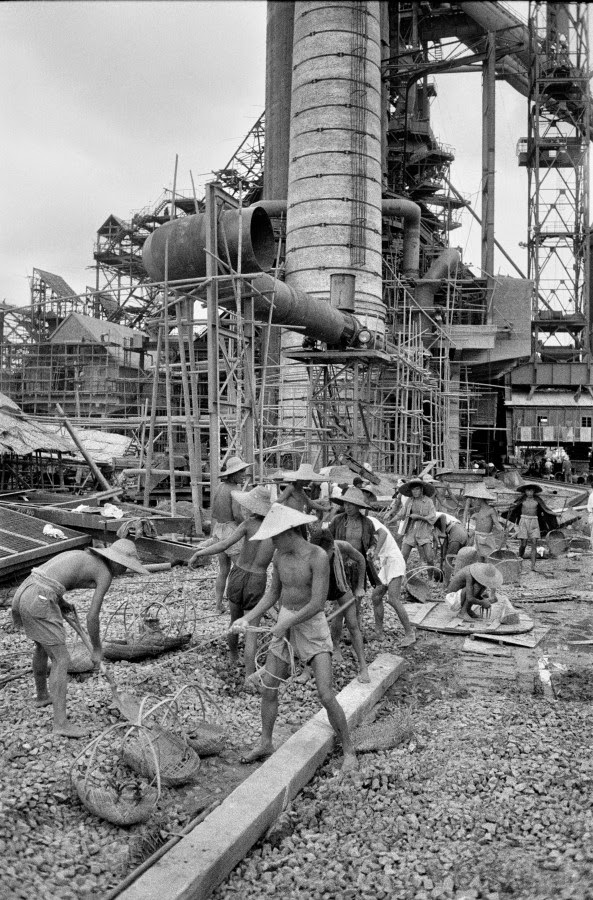
This picture shows that even under the rule of Mao Chinese citizens were worked with immense pressure and brutality. The people had to work with little protection on hard rocks and gravel. http://www.moma.org/


This picture shows the slogan that Mao wanted to display visually to all of the Chinese people, this translates to "Still bigger, Still better, More quickly, More frugally" http://www.moma.org/ 


Will and Shannon


 (1) The peasants are working to meet Mao’s quota of 10,700,000, tons of steel.


(2) Chinese organizers discuss their failure to produce enough oil to meet production quotas  In the back there is a sign attacking bourgeois rightist.


 (3) Chinese propaganda makers are putting pictures of Mao everywhere so people constantly have to see his face so that he will have more support from the people.


(4) Communist youth tear down a buddist statue. They are tearing it down because it represents a pre-communist China, which is against the ideals of the Cultural Revolution


(5) The party produced propaganda poster denouncing the Gang of Four for attempting to steal power from the party. 


Sources:
  1. http://www.moma.org/interactives/exhibitions/2010/henricartierbresson/#/themes/8/197.html
  2. http://www.moma.org/interactives/exhibitions/2010/henricartierbresson/#/themes/8/198.html
  3. http://www.morningsun.org/photos/photograph.swf
  4. http://www.morningsun.org/photos/photograph.swf
  5. http://www.chineseposters.net/themes/gang-of-four.php

Will and Shannon 


Mao Museum


This image shows the rate at which the communists were industrializing, they are using manpower to accomplish every task for industrialization, taking advantage of the large population.

This image shows the general theme of the cultural revolution, it shows a young man using a hammer to crush the artifacts of the past, showing the country's citizens willingness to follow Mao and remove old artifacts.


This image shows a vision of industrialized China, boasting all kinds of technology, and advancements in civilization.


This image shows the willingness of each worker to work for his country in order to advance his country.


This image shows the violence that Mao inspired in his followers during the cultural revolution.


Sources:
http://www.chineseposters.net/
http://www.moma.org/
http://www.morningsun.org/

Thursday, October 10, 2013

Diary of a Revolutionary War Woman ; Devin Pepe

1. The Revolutionary War has had a very large impact on my life. My husband has left me to go fight in the war. I am now left at home to take care of our family farm on my own.This job is very difficult considering my only job before this was to maintain the house and work the kitchen. This is very different than what I have ever experience before. I am also very lonely without my husband. Of course I am very proud of him for fighting for our freedom, but hope that he returns home safe very soon. 2. My husband has returned home again, but only for a short period of time. He leaves again in the morning. This time I am going with him and staying in a Patriot camp. I will be put to work on necessary tasks around the camp, such as cooking, cleaning and nursing. Although this seems like a very tough job, I will be happier with my husband by my side. Although many say this journey will be very difficult, I am happy to be doing anything I can to help this country and my husband. Any sacrifice will help gain our freedom that we deserve. 3. I am now at the Patriot camp with my husband. It is not at all luxurious, but I do not complain. Nothing is as bad as when I was left alone at home to take care of the farm. I have spent most of my hours of the day preparing meals, nursing to the wounded and maintaining the campsite. My husband says he is much happier with me around. There are also other women at the camp, but only a few. One woman even goes out to fight with the men, but I would never. I am very content with my role at the camp and happy to be helping my country in anyway I can.

Wednesday, October 9, 2013

Applying the American Revolution Classwork


Mistakes were Made
Lauren Yagoda 

Hello,
     Thank you for inquiring my advice regarding Britain’s current situation. I am sorry for your loss of the thirteen colonists, but I firmly believe that this ordeal could have been avoided. First, the instability of the Great Britain government played a large role in the tension leading up to the war. If you had not run the colonies inefficiently and loosely they would not have had the chance to form colonial assemblies or govern themselves. You then tried to recompense for the lose government, like King George I or II, Pitt, with strict officials such as the King George III, Townshend, North, or Grenville. This was a sudden change for the colonists, who had grown accustomed to self-governing. Therefore, if you wish to be a large empire then make sure your own government is stable first. Second, the communication with the colonies was very poor and led to feelings of resentment from the colonists. If you want to have a colony a three-day boat ride away, make sure you communicate with it. This could have been prevented through representation in Parliament, a major desire of the colonists. You can prevent this in the future through colonial ambassadors or Parliament representatives. If you had allowed for this one concession, the entire war would have been avoided. Lastly, policies in your colonies should be fair and just. For example, the Navigation Acts may have helped Britain’s economical trade, however America is part of the empire as well. Restricting their foreign trade only hurts their economy and angers colonists. Therefore, I hope you take my advice into consideration and account for political instability, communication, and legislature before developing any more colonies in the New World.
Sincerely,
Lauren

Tuesday, October 1, 2013

Mistakes were made
         Harsh punishments make them pull away even more.  After the Boston Tea Party, you responded by putting in place the Coercive Acts, shutting down Boston harbor, taking complete control of Massachusetts’s government, taking away their right to try British soldiers for crimes committed in Boston, and requiring them to provide housing for British troops.  These Acts caused the American colonists to feel their rights were being taken away.  Instead of these Acts, you could have punished the colonists by greatly raising taxes until the cost of the damage is paid off (plus extra for the inconvenience) then return them to equal or slightly higher than they were originally.
         Sudden, drastic, forced, changes in their government are a bad idea.  If they are used to governing themselves, don’t just suddenly take all of that away from them.  If you want tighter control, do it more gradually.  After the French and Indian war, you took much tighter control of the American colonies and started controlling aspects of government that had previously been controlled by American politicians.  Change scares people and a scared populace will place the blame on you, their leadership.

         Do not take away their rights!  Taking away their rights is the worst thing you can possibly do in the eyes of the people.  They will be forever against you if they begin to suspect it.  You made the Americans suspect it when you suddenly took away their right to representative government and made it possible to have trials without a jury.  Then they decided that every act passed after that was either in some way infringing on their rights, or that it was part of a British plot to slowly take away their rights.  Taking away the American colonists rights was really the main reason they began to turn away from Britain.